
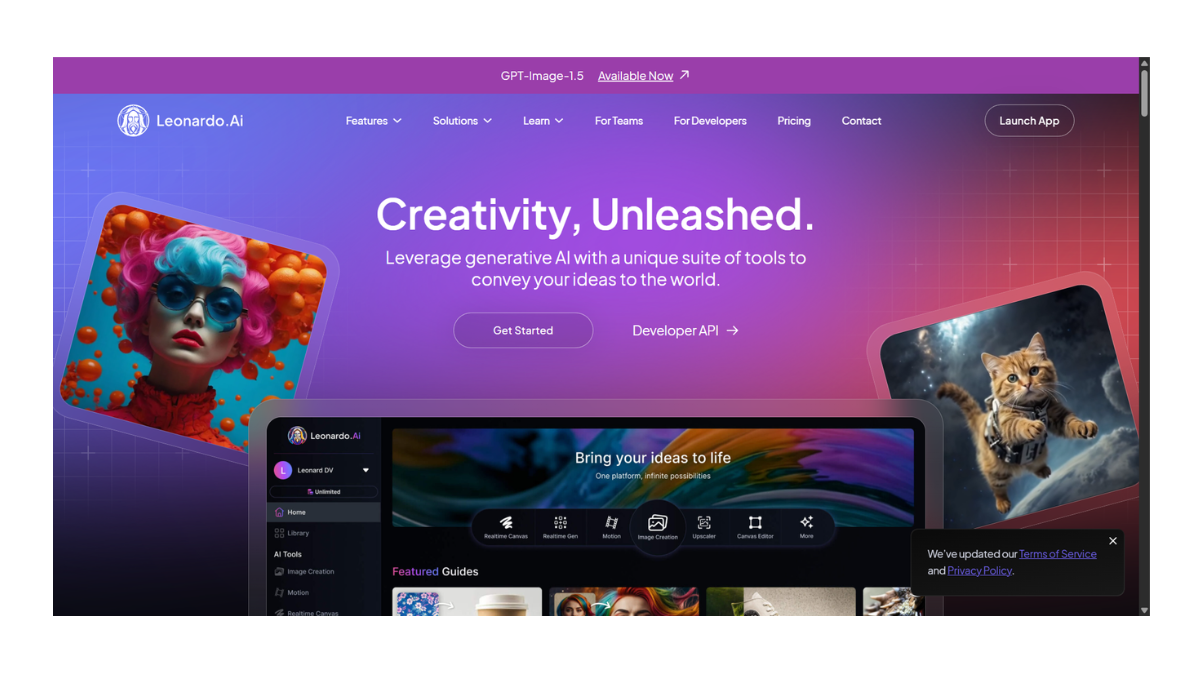
Leonardo.ai
Leonardo.ai is a powerhouse in the generative AI space, specifically built for creative professionals, game developers, and artists who need precise control over their assets.
While tools like Midjourney focus on making “beautiful art” with simple prompts, Leonardo focuses on utility and consistency—allowing you to generate specific game assets, train your own AI models, and edit images with granular control.
1. Core Purpose & Functionality
Leonardo is designed as a production suite rather than just an image generator.
-
Asset Generation: It excels at creating consistent characters, items, and environments for video games and graphic novels.
-
Model Training: Its killer feature. You can upload 10–20 images of a specific style or character, and it will “learn” that style, allowing you to generate hundreds of new images that look exactly like they belong in that same universe.
-
Real-time Canvas: A sketching interface where you draw a rough shape, and the AI turns it into a polished image in real-time as you move your mouse.
2. The AI Models
Leonardo offers a diverse range of models, including its own proprietary technology.
-
Leonardo Phoenix: Their latest flagship foundational model. It offers exceptional prompt adherence (it listens to instructions very carefully) and handles text within images better than most competitors.
-
Platform Models: It hosts fine-tuned versions of Stable Diffusion (like SDXL) optimized for specific looks like “3D Animation Style,” “Pixel Art,” or “Photorealism.”
-
Elements: These are “mini-models” (LoRAs) that you can toggle on/off to add specific flavors to your image (e.g., “Glasscore,” “Ebony & Gold,” “Inferno”) without changing your text prompt.
3. Key Features
-
Motion (Video): You can take any generated image and turn it into a 4-second video clip with a single click. It allows you to control the “Motion Strength” (how much the image moves).
-
Transparency: It creates native transparent backgrounds (PNGs), which is huge for sticker makers and game designers who don’t want to manually cut out backgrounds later.
-
Texture Generation: It can generate textures for 3D meshes, making it a favorite for 3D artists.
4. Pricing & Tiers
Leonardo uses a “Token” system. Every action (generating an image, upscaling, removing a background) costs a certain number of tokens.
-
Free Plan:
-
150 Tokens per day: This resets every 24 hours. This is enough for roughly 75 standard images per day—one of the most generous free tiers available.
-
No private image generation (images are public).
-
-
Apprentice (~$10-12/month):
-
8,500 tokens/month.
-
Private generations allowed.
-
-
Artisan (~$24-30/month):
-
25,000 tokens/month.
-
“Relaxed” Generation: This is a critical feature. If you run out of fast tokens, you can continue generating unlimited images at a slower speed.
-
5. Important Update: The Canva Acquisition
In July 2024, Canva acquired Leonardo.ai.
-
What this means for you: Currently, Leonardo still operates as a standalone website and tool. However, its technology (specifically the Phoenix model) is being integrated directly into Canva’s “Magic Media” tools.
-
Independence: For now, you can still use the independent Leonardo dashboard described above without needing a Canva subscription.
6. Leonardo vs. Midjourney
| Feature | Leonardo.ai | Midjourney |
| Control | High (ControlNet, Model Training) | Medium (Vary Region, Character Ref) |
| Consistency | Excellent (Train your own models) | Good, but harder to control |
| Interface | Web Dashboard (Complex but powerful) | Discord (Chat based) |
| Video | Built-in (Motion feature) | None (Images only) |
| Free Tier | Yes (Daily reset) | No (Paid only) |
- Pricing Model: FREE