
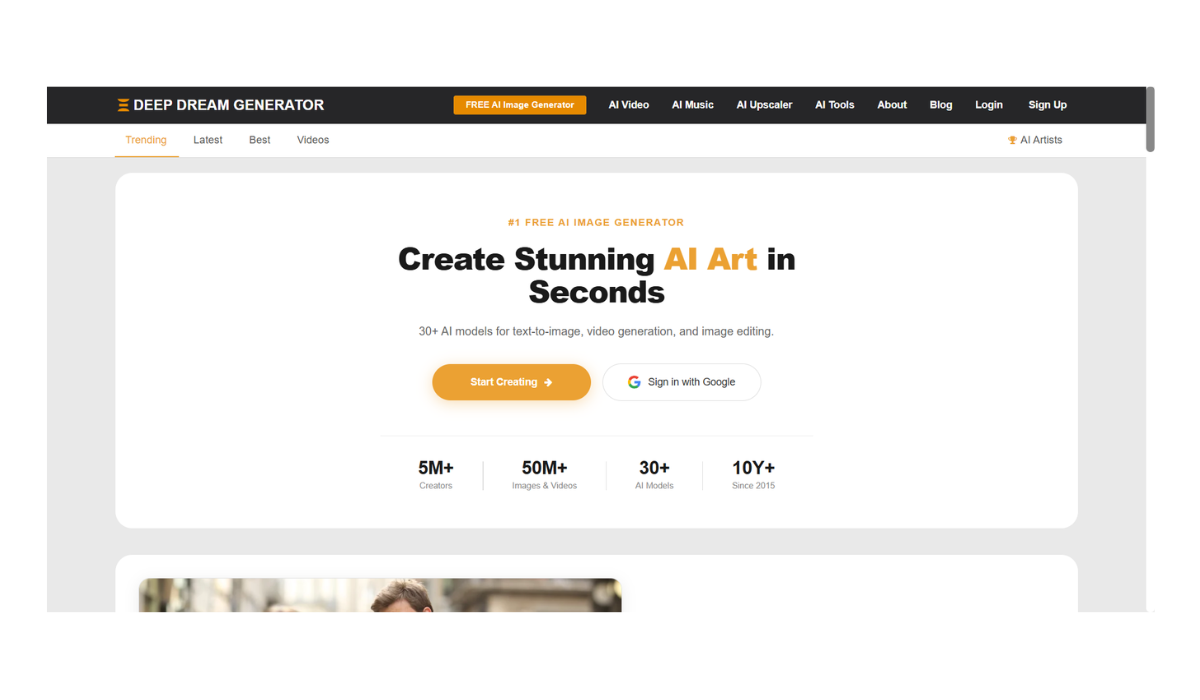
Deep Dream Generator
The Deep Dream Generator is a popular AI-based image manipulation tool originally developed by Google engineer Alexander Mordvintsev. It is best known for creating psychedelic, dream-like, and abstract art, though it has evolved to include more standard AI generation features like style transfer and text-to-image creation.
Here are the detailed aspects of the platform:
1. Core Features & Modes
The platform currently offers three main tools for creating images:
-
Text 2 Dream (Text-to-Image): This is the modern standard for AI art. You type a text prompt (e.g., “A cyberpunk city in the rain”), and the AI generates a completely new image based on your description. It uses models similar to Stable Diffusion.
-
Deep Style (Neural Style Transfer): This tool takes two images: a base image (your photo) and a style image (e.g., “The Starry Night” by Van Gogh). The AI repaints your base photo to look like it was painted in the style of the second image.
-
Deep Dream (Original Mode): This works by over-processing an image to find patterns that aren’t actually there (a phenomenon called pareidolia). It often results in images filled with eyes, faces, and animals, creating a trippy, hallucinogenic effect.
2. The “Energy” System & Pricing
Deep Dream Generator does not use a standard credit system but rather an “Energy” system. Every image you generate consumes Energy points.
-
Free Account: You get a set amount of energy when you sign up. However, the free tier is limited; once you run out, you must wait for a recharge or purchase a plan.
-
Subscription Plans: Paid plans offer more energy and faster recharging rates.
-
Advanced: ~$19/month (120 Energy pts, recharges at 12 pts/hour)
-
Professional: ~$39/month (250 Energy pts, recharges at 18 pts/hour)
-
Ultra: ~$99/month (750 Energy pts, recharges at 60 pts/hour)
-
-
Energy Consumption: A standard image might cost ~5 points. High-resolution or complex images (like “Quad HD”) cost significantly more energy.
3. Community & Social Features
Unlike some other AI tools that are purely utilities, Deep Dream Generator is built like a social network:
-
Feed: There is a global feed where users publish their creations.
-
Profiles: You have a user profile where you can showcase your art.
-
Interaction: You can “Like” and “Follow” other artists.
-
Trending: The “Trending” section showcases the most popular AI art of the day/week, which is a good place to find inspiration for prompts.
4. How It Works (The Tech)
-
Convolutional Neural Networks (CNNs): The original Deep Dream algorithm uses a CNN trained to recognize images (like dogs or buildings).
-
Inceptionism: Instead of identifying the object, the software is told to “enhance” whatever it sees. If a cloud looks slightly like a dog, the AI makes it look more like a dog. This loop repeats until the cloud looks like a surreal dog-cloud hybrid.
5. Pros and Cons
| Pros | Cons |
| Unique Aesthetic: The classic “Deep Dream” look is hard to replicate elsewhere. | Energy Limits: The free tier runs out of energy quickly. |
| Social Aspect: Great for sharing and seeing what others create. | Speed: High-resolution generation can be slower than newer tools like Midjourney. |
| User Friendly: Very easy interface with no coding required. | Style Transfer: While good, it is sometimes less controllable than modern ControlNets. |
- Pricing Model: FREE